
Aristotle Onassis's net worth at the time of his death in March 1975 is most credibly estimated at around $500 million, after liabilities. Some headlines put the figure closer to $1 billion, but that's the gross asset figure before roughly $421 million in outstanding bank loans on ships and real estate are subtracted. The net number, cited by Onassis's own lawyer and executor Stelio Papadimitriou and reported by Vanity Fair, lands at approximately $500 million. Adjusted for inflation, that translates to somewhere in the range of $2.7 billion in today's purchasing power, though you'll see different numbers depending on the conversion method used.
Aristotle Onassis Net Worth: Estate Snapshot to Today

Dimitri Papamichael
27 Mar 2026
Who Aristotle Onassis was and why his wealth still matters

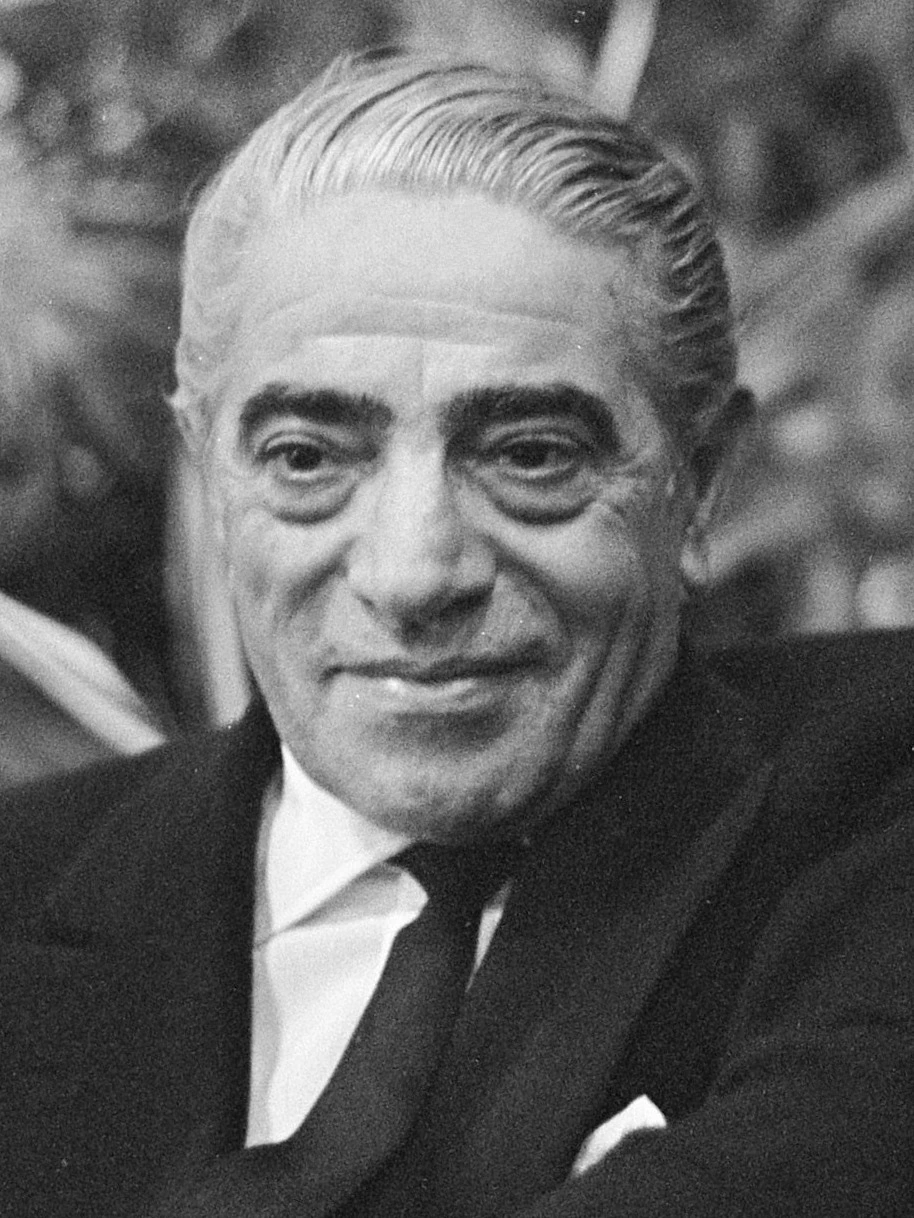
Aristotle Socrates Onassis (1906–1975) was a Greek shipping magnate and one of the most recognizable business figures of the twentieth century. Born in Smyrna (now Izmir, Turkey) and forced to rebuild after the Greco-Turkish War, he built a shipping empire essentially from scratch, starting in the 1930s and scaling dramatically after World War II. By the 1950s his supertanker fleet was among the largest in the world, and TIME was already calling him one of the most ambitious shipowners on the planet.
His wealth matters beyond the numbers for two reasons. First, he didn't just accumulate money: he pioneered an ownership model built on offshore holding companies, Panamanian-registered concerns, and flags of convenience that became the blueprint for modern global shipping. That structure, documented in detail by Cambridge business historians, is also what makes his net worth so difficult to pin down with precision, both then and now. Second, the Onassis fortune didn't disappear when he died. It flowed into what became the Alexander S. Onassis Foundation, one of Greece's most significant cultural and philanthropic institutions, and into the hands of his daughter Christina and eventually his granddaughter Athina. That inheritance chain is still relevant today.
What his estate actually looked like at death
Onassis died on March 15, 1975, in Paris, at age 69. The clearest picture of his estate comes from reporting that draws directly on the executor's account. Vanity Fair's detailed 2005 investigation, sourcing Papadimitriou, describes outstanding liabilities of about $421 million, mostly bank loans secured against ships and real estate holdings. Subtract that from the gross asset base and you arrive at an actual estate value of roughly $500 million.
The UPI reporting that describes a "$1 billion estate" is not necessarily wrong, it's just measuring something different: the gross asset value before debt. Both numbers appear in credible sources because they answer different questions. The gross figure tells you the scale of the enterprise. The net figure tells you what the heirs actually inherited. For net-worth purposes, the $500 million net figure is the more accurate baseline.
That estate was divided in two main directions. Christina Onassis, his daughter, inherited approximately 55% of the fortune directly. The remainder, and ultimately the bulk of the long-term wealth, flowed into the Alexander S. Onassis Foundation, which today operates as a public benefit foundation and continues to hold significant assets in shipping and other sectors. The Onassis net worth story is therefore partly a personal fortune story and partly a foundation story, and conflating the two is a common source of confusion in published estimates.
How these net worth estimates are built (and why they disagree)

There is no single audited balance sheet for Aristotle Onassis. His wealth was structured across multiple holding companies, Panamanian-registered entities, offshore accounts, and beneficial ownership stakes that were deliberately opaque. That's not speculation: Cambridge business historians document it as a deliberate operational strategy, not just tax convenience. The result is that anyone estimating his net worth, then or now, is working from indirect inputs.
The standard approach used by financial journalists and researchers is an assets-minus-liabilities model applied to observable or documented inputs. In Onassis's case, those inputs typically include: known fleet size and tanker valuations at the time of death, documented real estate holdings (including Skorpios island, the yacht Christina, and properties in Monte Carlo and New York), corporate equity stakes, and reported bank debt. When sources like Vanity Fair cite a specific liabilities number tied to a named source (Papadimitriou), that's about as close to a primary source as you'll get for a figure like this.
The reason estimates diverge comes down to a few key variables:
- Whether liabilities are subtracted or not (gross vs. net asset value)
- Which assets are included: some estimates count only the shipping fleet, others include real estate, art, and cash holdings
- How the foundation assets are treated: foundation-held wealth is not personal net worth, but some estimates blend the two
- The point-in-time valuation: tanker values fluctuated significantly in the early 1970s due to the oil crisis, so a 1973 valuation versus a 1975 valuation would look very different
- Cross-border holding structures: Greek authorities and Panamanian registrations produced different tax-basis valuations for the same assets, as documented in the Washington Post's reporting on Christina's inheritance tax dispute
This is worth understanding because the same structural complexity applies to any inflation-adjusted or "today's equivalent" figure you see published. They're not wrong so much as they're built on different starting assumptions.
What $500 million in 1975 is worth today
The most commonly cited modern equivalent puts Onassis's $500 million (1975) at approximately $2.7 billion in today's purchasing power. That figure uses standard US Consumer Price Index inflation conversion, which is the most straightforward method and the one most inflation calculators apply. A closer look at the Aristotle Onassis net worth in 1975 shows how those calculations break down year by year.
It's worth flagging why that number can vary across sources. CPI-based conversion measures general consumer purchasing power, which isn't the same as asset-class appreciation. A shipping magnate's wealth in 1975 was concentrated in physical assets (tankers, real estate, corporate equity) that may have appreciated at different rates than general inflation. Some researchers use GDP deflators or asset-specific indices instead of CPI, which produces a different result. A figure of $1.4 billion, for example, corresponds roughly to a $250 million starting point in 1975 dollars using a similar CPI method, which aligns with what Flavor365 cites in reference to Christina's inheritance share rather than the full estate.
| Starting figure (1975 USD) | Modern equivalent (approx.) | What it represents | Method basis |
|---|---|---|---|
| $500 million | ~$2.7 billion | Net estate value after liabilities | CPI inflation adjustment |
| $1 billion | ~$5.4 billion | Gross asset value before debt | CPI inflation adjustment |
| $250 million | ~$1.4 billion | Christina's approximate inheritance share | CPI inflation adjustment |
None of these figures should be treated as a precise number. They're illustrative equivalents that help place 1975 money in a contemporary context. When you see a published figure for Onassis's net worth "today," the most important thing to check is which starting point was used and whether the conversion accounts for the foundation assets separately. If you're also comparing political wealth figures, see the president Aristide net worth context and what those estimates rely on.
The granddaughter: who is she and what is her net worth?

When people search for "Aristotle Onassis granddaughter net worth," they're almost always asking about Athina Onassis Roussel, born in 1985 and the only child of Christina Onassis. She is Aristotle's sole grandchild and the only direct lineal heir to the Onassis fortune. Christina died in 1988, when Athina was just three years old, leaving her under the guardianship of her father, Thierry Roussel. Athina came into control of her inheritance at 18, in 2003.
Her fortune is genuinely contested in the reporting. The Independent placed her net worth at approximately £2.5 billion on her 18th birthday in 2003, an asset-inclusive estimate that counted Skorpios island, a Monte Carlo hotel, bank accounts, and her stake in the Onassis shipping fleet. Forbes, that same year, pushed back directly, questioning whether she was "really a billionaire" and noting that her actual fortune appeared to fall short of the $1 billion figure being widely attributed to her. ABC News (Mar. 13, 2003) framed the question of whether Athina Onassis was really a billionaire, citing press reports that her inheritance trust could be worth up to billions while highlighting disputes and uncertainty around the valuation disputes and uncertainty over how much Athina Onassis’s inheritance trust is actually worth.
The situation evolved further. Athina sold Skorpios in 2013 to Russian billionaire heiress Ekaterina Rybolovleva, a transaction confirmed by Forbes. The island sale price was reported in the range of $100–153 million, depending on the source. By 2023, GreekReporter.com cited estimates placing her personal fortune at around $500 million, with a breakdown including deposits, company investments, and other assets, noting that her fortune had declined significantly from earlier estimates.
The honest answer on Athina's current net worth is that it's unknown with precision. Wikipedia's entry on her explicitly states her true wealth "remains unknown. Wikipedia also notes that estimates of Athina Onassis’s net worth vary and that some accounts claim it is below $1 billion blank" rel="noopener noreferrer">Wikipedia's entry on her explicitly states her true wealth "remains unknown.. " What we can say with reasonable confidence, drawing on the Forbes reporting and more recent Greek media coverage, is that her fortune is probably in the range of $500 million to $1 billion, closer to the lower end of that range given reported management disputes, foundation structures, and the Skorpios sale. She is not a billionaire in any reliably documented sense, though some outlets continue to describe her as one.
Where the money went and what the foundation holds
A piece of the Onassis wealth picture that often gets undercounted in personal net-worth discussions is the Alexander S. Onassis Foundation. Aristotle structured a significant portion of his estate so that it would pass into this foundation rather than to individual heirs. The foundation today operates shipping interests, cultural programs, and scholarship funds. Its assets are not Athina's personal net worth, and they are not included in most published estimates of her fortune, but they represent a substantial continuation of Onassis's original wealth.
This matters when you're trying to interpret the full scale of what Onassis built. The $500 million net estate figure is a personal fortune snapshot. The foundation's long-term asset base, which UPI described in 2000 as "nearly twice" the original estate value, represents a separate pool of wealth that has compounded since 1975 under institutional management. The two streams (personal inheritance to Athina, institutional assets in the foundation) are distinct and should be evaluated separately.
Quick takeaways and how to verify the current figures
Here's the practical summary if you want the clearest possible answer on each number:
- Onassis's net worth at death (1975): ~$500 million net of liabilities, or ~$1 billion gross. The $500M figure, sourced to his executor, is the more defensible net-worth number.
- Modern equivalent: ~$2.7 billion in today's purchasing power using CPI inflation conversion from the $500M baseline. Treat any specific figure as an approximation, not a precise valuation.
- Athina Onassis Roussel is the granddaughter referenced in searches. Her personal fortune is estimated at $500 million to $1 billion, with more recent reporting suggesting the lower end of that range after asset sales and management costs.
- The Onassis Foundation holds additional assets separately from Athina's personal wealth. It is not included in her net-worth estimates.
- Numbers diverge across sources mainly because of gross vs. net starting points, which assets are counted, and how foundation holdings are treated. Always check which assumptions a source is using.
To verify the most current figures, a few practical steps are worth taking. First, check this site's most recent editorial updates on the Onassis fortune, since figures are reviewed as new reporting becomes available. Second, for Athina's wealth specifically, Forbes and major Greek financial media (like GreekReporter.com) tend to publish the most grounded estimates: cross-reference at least two sources and note the date, since her financial situation has changed materially over time. Third, for the foundation's asset base, the Onassis Foundation publishes public benefit reports that give some indication of institutional scale, even if they don't publish a full balance sheet. Finally, remember that for any shipping magnate whose wealth was structured through offshore holding companies and Panamanian-registered entities, you're always working with estimates rather than disclosed financials. That's not a flaw in the reporting: it's a structural feature of how this kind of wealth was organized. Aristos Petrou's net worth is another case where Greek-diaspora shipping wealth runs into similar estimation challenges, and the methodology applies across the sector.
FAQ
If Aristotle Onassis had about $500 million in net assets in 1975, why do some articles still label it as “$1 billion” after his death?
Those pieces are usually quoting gross asset value, not what remained after debt. In Onassis’s case, the commonly cited split is about $500 million net after roughly $421 million in liabilities, while the $1 billion-style figure represents assets before subtracting loans, often tied to ships and real estate.
Which inflation method should I trust for “today’s equivalent” of Onassis’s 1975 wealth, CPI or something else?
CPI conversion is the simplest and most commonly used, but it can mislead for asset-heavy fortunes like shipping and real estate. A more apples-to-apples approach is to use an asset-specific appreciation method (or at least a sensitivity range), because shipping and property can move very differently from consumer prices.
Does Onassis’s $500 million “net worth” include the Alexander S. Onassis Foundation assets?
Not in most personal net-worth estimates. The article distinguishes his personal estate snapshot (net estate) from the foundation’s separate institutional pool. If a source mixes them, you can end up overstating what Athina inherited personally.
When estimating Onassis net worth, what liabilities are most likely to be missed or double-counted in casual estimates?
Estimates often struggle with debt at the entity level, intercompany loans, and credit secured against specific vessels or properties. If an article subtracts liabilities using one layer of accounts while valuing assets using another layer, the result can swing meaningfully.
How should I interpret “Athina Onassis Roussel net worth” figures that change dramatically by year?
Treat year-to-year updates as changes in valuation assumptions, not just business performance. Her stake values, especially around big assets like Skorpios and her interests in shipping-related holdings, can shift quickly with sale prices, court or management disputes, and fluctuating market sentiment.
Did Athina become the owner of everything immediately at age 18 in 2003?
Not necessarily in the way people assume. Her inheritance was tied to the family’s broader estate structure and ongoing management decisions, so “control at 18” does not always mean every underlying asset is valued or accessible the same way at that exact date.
Why do Forbes-like estimates sometimes conclude “not a billionaire” even when other outlets call Athina a billionaire?
The key difference is often what assets are counted (personal holdings only versus broader exposure through structures) and which valuation date is used. A headline figure can be derived from asset-inclusive valuations that later get narrowed once disputes, liquidity limits, or discounting are applied.
Does the Skorpios sale automatically settle the debate about Athina’s net worth?
It helps with one large line item, but it does not fully resolve valuation uncertainty. Other holdings like company interests, bank deposits, and any remaining shipping-related exposures still require opaque structure assumptions, and those can outweigh or offset the Skorpios component depending on the year.
For Onassis, why is it hard to find an audited “balance sheet” figure?
Because his wealth was distributed across multiple holding companies and offshore-registered entities with limited public disclosure. Without consolidated audited statements for the whole structure, researchers rely on documented asset valuations and specific reported debts, which inevitably creates estimation ranges.
If I want the most reliable number to cite, what should I look for in a source?
Look for (1) whether the figure is gross or net, (2) the named liabilities source, (3) whether foundation assets are separated from personal assets, and (4) the inflation methodology and base year. The best citations usually state the starting point and what was subtracted or excluded.
Next Article
President Aristide Net Worth: Estimated Range and Proof Steps
Estimate Jean-Bertrand Aristide net worth range, what drives assets, and steps to verify claims using public records.